
Bridge Steel Plate
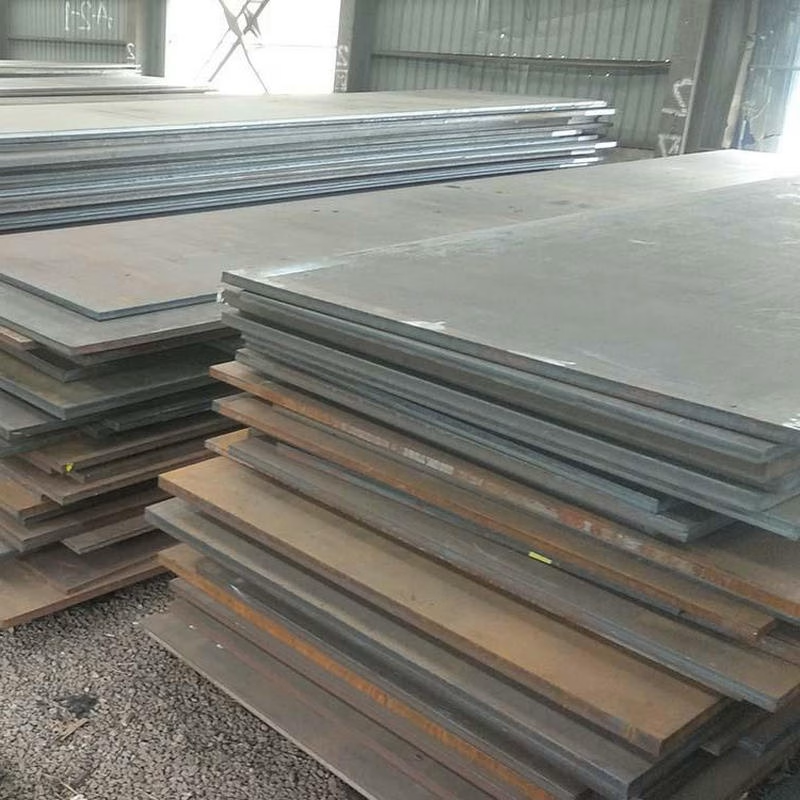
Bridge steel plate is a high-performance structural plate engineered for long-span bridges, overpasses, and infrastructure, offering a combination of high strength, toughness, weldability, and often atmospheric corrosion resistance.
Material
High-Strength Low-Alloy (HSLA) and Weathering Steel. Common grades include ASTM A709 Gr. 50, Gr. 50W, Gr. HPS 70W; EN 10025-5 S355J2W+N, S460N; JIS G3114 SMA490AW, SMA570W; GB/T 714 Q345qD, Q420qE.
Model
HPS Plate, Corten-B Plate
Size
Standard widths from 1500 mm to 4500 mm; lengths up to 25000 mm. Often supplied as flame-cut or plasma-cut shapes.
Thickness
6 mm to 200 mm, with common applications in the 10 mm to 100 mm range for main girders.
Standard
ASTM A709/A709M, EN 10025-5, JIS G3114, GB/T 714. Compliant with design codes like AASHTO LRFD, Eurocode 3.
MOQ
20 Metric Tons.
Delivery Time
Standard lead time is 5 to 10 weeks from order confirmation, depending on grade, cutting requirements, and certification.
Long Description
Bridge steel plate is a specialized product category developed to meet the demanding mechanical and environmental requirements of modern bridge construction. It encompasses several sub-classes, including conventional high-strength low-alloy (HSLA) grades, weathering steels (which form a protective patina), and advanced high-performance steel (HPS) grades produced via quenching and tempering (Q&T). Key design considerations for this product include a high yield-to-tensile strength ratio, excellent notch toughness at low service temperatures to prevent brittle fracture, exceptional fatigue resistance under cyclic loading, and ease of fabrication through welding and cold forming. Plates are supplied to stringent national and international bridge construction standards, which dictate chemical composition, mechanical properties, and often mandatory Charpy V-notch impact testing to ensure structural integrity and longevity over decades of service.
Key Product Highlights
Bridge plates provide an optimal strength-to-weight ratio, enabling lighter, more economical bridge designs.
Weathering steel grades offer long-term corrosion resistance, eliminating the need for painting in many environments.
The product exhibits superior low-temperature impact toughness to withstand dynamic loads and harsh climates.
Advanced Q&T grades (e.g., HPS 70W) allow for reduced plate thickness and lower fabrication costs.
Consistent through-thickness properties and flatness are critical for stability during fabrication and in service.
Product Advantages
Material properties are certified to meet exacting national and international bridge design codes (AASHTO, EN, JIS).
The use of weathering steel significantly reduces lifecycle maintenance costs for suitable applications.
High-strength grades enable longer spans, fewer piers, and reduced foundation requirements.
Excellent weldability with common procedures minimizes pre-heat requirements and ensures joint integrity.
Full traceability and mill test reports support rigorous quality assurance and project documentation.
Industry Application
This plate is used in the fabrication of bridge girders (welded I-beams, box girders), orthotropic decks, splice plates, cross-frames, bearing components, and other primary load-bearing members in highway, railway, and pedestrian bridges.
Technical Specifications
| Parameter | Unit | Weathering Steel (e.g., 50W) | High-Performance Steel (e.g., HPS 70W) | Notes |
|---|---|---|---|---|
| Carbon Content (C) | % | ≤ 0.19 | ≤ 0.11 | Lower in HPS for superior weldability. |
| Manganese (Mn) | % | 0.80 – 1.35 | 1.20 – 1.60 | Alloying for strength and hardenability. |
| Phosphorus (P) | % | 0.04 max | ≤ 0.020 | Controlled; part of weathering alloy in Corten. |
| Sulfur (S) | % | ≤ 0.05 | ≤ 0.006 | Very low in HPS for improved toughness and formability. |
| Tensile Strength | MPa | 485 – 620 | 760 – 895 | Grade and condition dependent. |
| Yield Strength | MPa | ≥ 345 (50W) | ≥ 485 (70W) | Minimum specified yield point. |
| Elongation | % | ≥ 19 | ≥ 19 | Minimum in 50mm gauge length. |
| Hardness | HB | N/A | N/A | Not a primary specified property for bridges. |
| Thickness | mm | 6 – 100 | 6 – 100 | Yield strength may decrease with increased thickness. |
| Width | mm | 1500 – 4500 | 1500 – 4000 | Standard plate mill capabilities. |
| Coil Weight | MT | N/A | N/A | This product is supplied as plates, not coils. |
| Surface Treatment | – | As-Rolled (mill scale) | As-Rolled, Blast Cleaned | Weathering steel develops patina; HPS is often painted. |
| Coating / Finish | – | Unpainted (for patina formation) | Quenched & Tempered (QT) | Delivery condition defines final properties. |
| Rolling Type | – | N/A | N/A | Parameter is specific to coil products. |
| Standard Example | – | ASTM A709 Grade 50W | ASTM A709 Grade HPS 70W | Representative grade from key bridge standard. |
Packaging & Surface Treatment
Plates are bundled on sturdy steel skids with protective timber between layers to prevent surface damage during handling and transit. Bundles are securely strapped with steel bands. For weathering steel, care is taken to avoid contamination that could disrupt uniform patina formation. The surface is typically supplied as-rolled with mill scale, which is acceptable for weathering grades, or blast-cleaned to Sa 2.5 for grades requiring immediate priming and painting.
Aliases Names
Structural Bridge Plate, HPS Plate, Corten Bridge Plate, Weathering Steel Plate, High Strength Quenched & Tempered Plate.